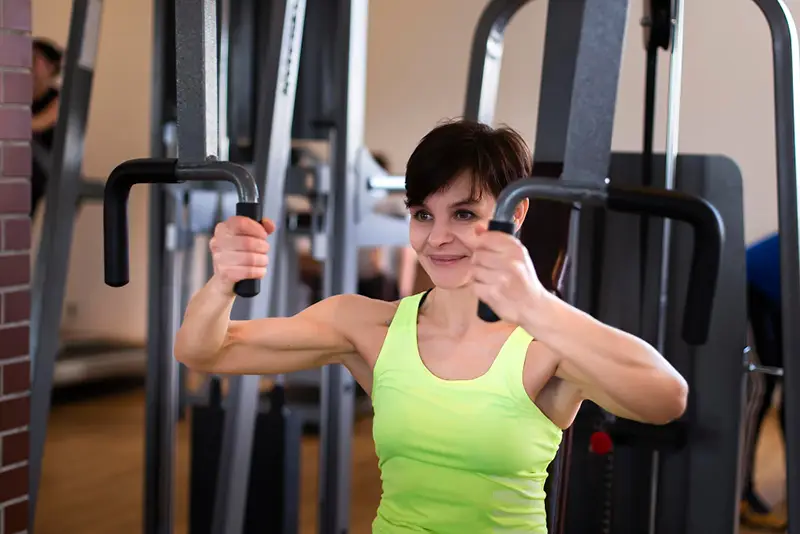
If you’re a woman over 40 and you’ve been noticing changes in your body that feel harder to explain (more fat around the midsection, less muscle tone, slower recovery, lower energy) you’re not imagining it. These changes are real, and they’re largely driven by hormonal shifts that begin in perimenopause. Strength training for women over 40 is one of the most evidence-backed responses to these changes.
This guide explains what’s happening in your body, why lifting weights matters more now than ever, and how to approach it in a way that works for your life.
What Happens to Your Body After 40
The changes women experience in their 40s and early 50s are not just about aging in general, they’re specifically tied to declining estrogen levels. Estrogen plays a significant role in maintaining muscle mass, bone density, and metabolic function. As it drops during perimenopause and menopause, several things happen simultaneously.
Muscle loss accelerates. The body naturally loses 3 to 5 percent of muscle mass per decade starting around age 30, but this process can speed up significantly around menopause. A 2021 study published in PMC found that the prevalence of sarcopenia (the clinical term for age-related muscle loss) was notably higher in late perimenopausal and postmenopausal women compared to premenopausal women. Less muscle means a slower metabolism, reduced strength, and a higher risk of injury from everyday activities.
Bone density declines. Estrogen helps protect bone tissue. When estrogen drops, bone loss accelerates, increasing the risk of osteoporosis and fractures. According to the Mayo Clinic, putting mechanical stress on bones through weight-bearing exercise is one of the most effective ways to slow this process and maintain bone mineral density during and after menopause.
Body composition shifts. Even women who maintain the same weight often notice more fat accumulating around the abdomen. This is partly driven by hormonal changes and partly by the metabolic slowdown that comes with muscle loss. The two reinforce each other: less muscle means fewer calories burned at rest, which makes fat gain easier and fat loss harder.
Why Strength Training for Women Over 40 Is Different — and More Important
For most of their lives, women have been directed toward cardio: running, cycling, aerobics classes.
Cardio has real benefits for cardiovascular health and mood. But it does relatively little to address the specific challenges of perimenopause and menopause: muscle loss, bone density decline, and metabolic slowdown. Strength training does.
A 2023 study published in PMC found that resistance training was effective in counteracting both age-related and menopause-related loss of muscle mass and strength in women aged 40 to 60. A landmark 2024 study reported by NPR found that women who performed strength training two to three days per week had a significantly lower risk of death from cardiovascular disease and all causes compared to women who did not strength train. These are not marginal benefits, they represent a meaningful difference in long-term health outcomes.
There is also a common concern worth addressing directly: many women over 40 worry that lifting weights will make them “bulky.” This concern is not supported by the evidence. Women have significantly lower testosterone levels than men, which limits the degree of muscle hypertrophy they can achieve through standard resistance training. What strength training does produce in women is a leaner, more defined appearance, along with the functional and metabolic benefits described above.
Benefits of Strength Training for Women Over 40<
The evidence on strength training for women over 40 is substantial and consistent across multiple areas of health.
| Benefit | What the Research Shows |
|---|---|
| Muscle preservation | Resistance training counteracts sarcopenia and maintains functional strength |
| Bone density | Weight-bearing exercise slows bone loss and can improve bone mineral density |
| Metabolic health | Building muscle increases resting metabolic rate and improves insulin sensitivity |
| Cardiovascular health | 2–3 sessions/week associated with lower risk of heart disease mortality |
| Mood and mental health | Resistance training reduces symptoms of anxiety and depression in midlife women |
| Functional capacity | Improves balance, coordination, and ability to perform daily activities |
A 2024 review published in Science Direct on exercise for peri- and postmenopausal women concluded that resistance training produces improvements across functional capacity, cardiovascular health, metabolic health, and maintenance of healthy body weight. These benefits are not reserved for women who have been training for years, they are accessible to women who start in their 40s or 50s, even with no prior strength training experience.
How to Approach Strength training for women over 40
The principles of effective strength training don’t change dramatically after 40, but a few adjustments in approach make the process safer and more sustainable.
- Start with compound movements. Exercises that work multiple muscle groups simultaneously (squats, deadlifts, rows, presses, lunges) deliver the most benefit per unit of effort. They build functional strength, stimulate more muscle tissue, and have a greater effect on metabolism than isolation exercises.
- Prioritize recovery. After 40, recovery takes longer. Training the same muscle group on consecutive days is less effective and increases injury risk. Most women in this age group do well with 2 to 4 strength training sessions per week, with at least one rest day between sessions targeting the same muscles.
- Use progressive overload. The principle of gradually increasing the challenge, adding weight, reps, or sets over time, is what drives continued adaptation. Without progressive overload, the body adapts to the current stimulus and stops changing. This applies equally to women over 40 as it does to any other population.
- Pay attention to protein intake. Muscle protein synthesis becomes less efficient with age, a phenomenon called anabolic resistance. Consuming adequate protein (research supports a target of 1.6 to 2.0 grams per kilogram of body weight per day) helps counteract this and supports muscle maintenance and growth.
- Manage stress and cortisol. High cortisol levels (often elevated by chronic stress, poor sleep, or excessive high-intensity cardio) can accelerate muscle breakdown and fat storage, particularly around the abdomen. Strength training at moderate intensity helps regulate cortisol response, while excessive cardio can sometimes worsen it. This is one reason why replacing some cardio sessions with strength training often produces better body composition results for women in this age group.
How PersonalGO Supports Strength Training for Women Over 40

Starting or restarting a strength training program after 40 is one of the most impactful decisions a woman can make for her long-term health. The challenge is often not motivation, it’s knowing where to start, how to progress, and staying consistent once life gets in the way. This is exactly where having the right professional by your side makes all the difference.
Find a Personal Trainer Who Understands Your Needs
PersonalGO connects you with certified personal trainers who can design a strength training program built specifically for your body, your goals, and your current fitness level. A trainer who understands the specific needs of women over 40 (hormonal changes, recovery capacity, movement history) can create a progressive plan that delivers results while keeping you safe. Whether you prefer in-person sessions or the flexibility of online coaching, PersonalGO makes it easy to find the right professional and get started.
Access a Library of Strength Training Exercises
The app includes a library of exercises with video demonstrations, so you can perform every movement your trainer prescribes with correct technique, which is especially important when starting out or returning to training after a break. Proper form reduces injury risk and ensures you’re getting the full benefit from each exercise your program includes.
Track Your Progress and Stay Consistent
PersonalGO allows you to log every session, track your performance over time, and see your progress week by week. Consistency is the most important variable in long-term results, and having a clear record of what you’ve done, and how far you’ve come, makes it much easier to stay on track between sessions with your trainer.
If you want to start building strength in a way that fits your life, PersonalGO connects you with certified trainers who can design a program specifically for women over 40, and gives you the tools to track every step of your progress.
The Bigger Picture: Strength as a Long-Term Investment
Strength training for women over 40 is not about aesthetics, though the physical changes are real and meaningful. It is about building and preserving the physical capacity that determines quality of life in the decades ahead. The women who invest in their strength now are the ones who will be able to carry their groceries, play with their grandchildren, travel, and live independently well into their 70s and 80s.
The research is clear. The tools are accessible. The only thing that remains is starting and then showing up consistently enough to let the adaptation happen.
Ready to invest in your long-term health? Download PersonalGO to build a strength training program designed for your schedule, or connect with a certified trainer who can create a plan tailored to where you are right now.
References
[1] Office on Women’s Health. (2024 ). Sarcopenia and Menopause. U.S. Department of Health & Human Services.
[2] Jupil, K.O. & Young-Min, P. (2021 ). Menopause and the Loss of Skeletal Muscle Mass in Women. Iranian Journal of Public Health. PMC.
[3] Mayo Clinic News Network. (2024 ). Perimenopause, Menopause and Weightlifting: Expert Explains Value for Bone Health.
[4] Isenmann, E. et al. (2023 ). Resistance training alters body composition in middle-aged women. PMC.
[5] NPR Health. (2024 ). Women who do strength training live longer. How much is enough?
[6] Godoy-Izquierdo, D. et al. (2024 ). Exercise for peri- and postmenopausal women. Maturitas / Science Direct.
[7] University of Exeter. (2025 ). First-of-its-kind study shows resistance training can improve physical function during menopause.
[8] Svensen, E. et al. (2024 ). A novel low-impact resistance exercise program increases strength and balance in females irrespective of menopause status. BMJ Open Sport & Exercise Medicine. PMC.
[9] Morton, R.W. et al. (2018 ). A systematic review, meta-analysis and meta-regression of the effect of protein supplementation on resistance training-induced gains in muscle mass and strength. British Journal of Sports Medicine.
[10] TryOn Med. (2021 ). Exercise for menopause: 3 ways to adapt your workouts after 40.