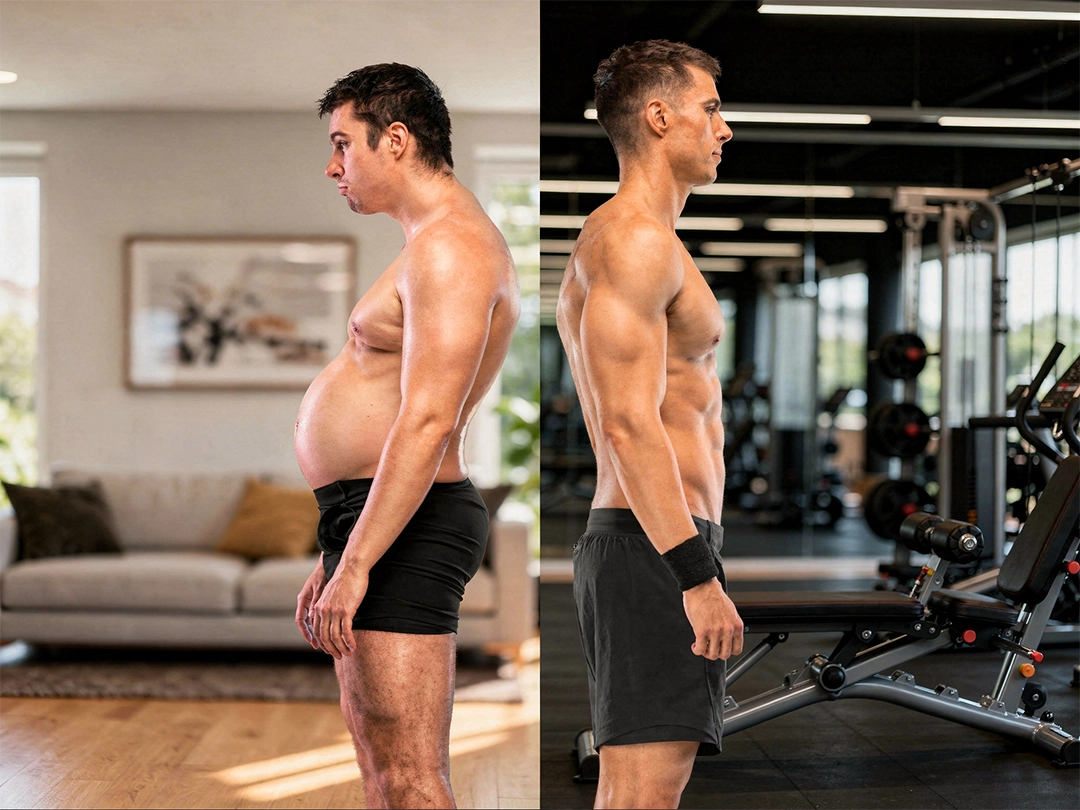
You’ve been consistent for months. You hit your goal weight, but when you look in the mirror, something is off. You don’t look as lean or as strong as you had hoped. This frustrating situation is incredibly common, and it happens when the focus is solely on losing weight instead of on body recomposition.
True transformation isn’t just about the number on the scale going down. It’s about changing the composition of that weight: reducing body fat while simultaneously building or maintaining lean muscle mass. This is the essence of body recomposition, and it requires a smarter strategy.
What Is Body Recomposition? (And Why the Scale Is Lying to You)
Body recomposition is the process of reducing body fat percentage while increasing lean muscle mass, often with little to no change in total body weight. This is why the scale can be misleading.
Here’s the problem: muscle is denser than fat. You can lose 5 pounds of fat and gain 5 pounds of muscle—your weight stays the same, but your body looks completely different. You’re leaner, more defined, stronger. Yet the scale says nothing changed.
This is why body recomposition is superior to traditional “bulking” and “cutting” phases. You get the best of both worlds: fat loss and muscle gain, simultaneously.
The Science Behind Losing Fat and Building Muscle at the Same Time
For years, conventional wisdom said you had to choose: eat in a surplus to build muscle, or eat in a deficit to lose fat. You couldn’t do both.
But research has changed this narrative. Studies show that body recomposition is absolutely achievable, especially for:
- People new to structured strength training
- Returning to training after a break
- With higher body fat percentages
The mechanism is simple: your muscles need a reason to grow (progressive overload through strength training) and your body needs a reason to tap into fat stores (a modest calorie deficit). When both conditions are met, your body preferentially builds muscle while burning fat.
The 3 Pillars of Successful Body Recomposition
Body recomposition isn’t complicated, but it does require consistency in three specific areas. Think of them as the foundation of your results.
Pillar 1: Progressive Overload in Strength Training
Progressive overload is the principle of gradually increasing the demands on your muscles over time. Without it, your muscles have no reason to grow.
This means:
- Increasing weight lifted
- Increasing reps or sets
- Improving exercise form
- Decreasing rest periods
You don’t need to increase everything at once. Even adding one more rep per week counts. The key is systematic progression, not random effort.
Why it matters for body recomposition: Progressive overload is the signal that tells your body to build and retain muscle, even while in a calorie deficit.
Pillar 2: Calorie Deficit + High Protein Diet
To lose fat, you must consume fewer calories than you burn. But here’s the catch: a drastic deficit causes your body to break down muscle for energy.
The solution: A modest deficit of 200-400 calories below maintenance, combined with high protein intake.
Protein recommendations for body recomposition:
- 1.6 to 2.2 grams per kilogram of body weight
- Or roughly 0.7 to 1 gram per pound of body weight
This high protein intake provides the amino acids your muscles need to repair and grow, even in a deficit.
Pillar 3: Sleep and Recovery
Your muscles aren’t built in the gym. They’re built while you sleep.
During sleep, your body:
- Releases growth hormone
- Repairs damaged muscle fibers
- Consolidates learning and adaptation
Aim for 7-9 hours of quality sleep per night. This is non-negotiable for body recomposition.
How to Track Body Recomposition Progress (Beyond the Scale)
This is critical: stop weighing yourself daily. The scale fluctuates based on water retention, food in your stomach, hormones, and dozens of other factors unrelated to fat loss or muscle gain.
Instead, track these metrics:
Progress Photos and Body Measurements
Progress photos (every 2-4 weeks):
- Take photos from the front, side, and back
- Use consistent lighting and clothing
- Compare photos 4 weeks apart (not week-to-week)
Body measurements (weekly or bi-weekly):
- Waist (at navel level)
- Hips
- Chest
- Arms
- Thighs
Measurements often show progress before the mirror does.
How to Do Body Recomposition on PersonalGO

Here’s where PersonalGO becomes your secret weapon for body recomposition success.
Step 1: Build Your Workout Program
PersonalGO’s exercise library contains over 4,000 video demonstrations. You can browse by muscle group, equipment, or difficulty level. Each video shows proper form, common mistakes, and variations.
You can:
- Create your own workout from scratch
- Connect with a certified personal trainer who designs a custom body recomposition plan for you
The app makes it easy to build a program that emphasizes progressive overload—the foundation of muscle growth.
Step 2: Log Every Workout
Consistency is tracked, not guessed. The app remembers your previous performance, making it obvious when you’ve hit progressive overload (more weight, more reps, or better form).
Step 3: Track Body Composition with AI Scanning
This is where PersonalGO’s AI Body Scanning (Premium Plan) becomes invaluable for body recomposition.
Instead of relying on weight or measurements alone, you get a detailed breakdown of:
- Body fat percentage
- Lean muscle mass
- Muscle distribution by body part
Recommendation: Perform a body scan once per month. This gives you objective data on whether you’re truly losing fat and gaining muscle—the definition of body recomposition.
Step 4: Connect with a Personal Trainer (Optional)
If you want expert guidance, PersonalGO’s marketplace lets you connect with certified trainers. They can:
- Assess your current fitness level
- Design a body recomposition plan tailored to your goals
- Monitor your progress through the app
- Adjust your program as needed
Body Recomposition Timeline: What to Expect
Weeks 1-2: You’ll feel more organized and confident. You’re building the habit.
Weeks 3-4: You might notice clothes fitting differently. Energy levels often improve.
Weeks 5-8: Visible changes become apparent. Progress photos show clear differences. Performance in the gym improves noticeably.
Weeks 8-12: Significant transformation. People around you start commenting. This is when body recomposition becomes undeniable.
3-6 months: Major body composition changes. You look noticeably leaner and stronger. The scale might be the same, but you’re a different person.
Ready to transform your physique? Download PersonalGO to track the metrics that matter for body recomposition and get your personalized plan.
References
[1] Schoenfeld, B. J., et al. (2016). Body composition changes associated with fasted versus non-fasted aerobic exercise. Journal of the International Society of Sports Nutrition.
[2] Helms, E. R., et al. (2014 ). A systematic review of natural bodybuilding competition preparation and recovery. Journal of the International Society of Sports Nutrition.
[3] Schoenfeld, B. J. (2010 ). The mechanisms of muscle hypertrophy and their application to resistance training. Journal of Strength and Conditioning Research.
[4] Helms, E. R., et al. (2014 ). A systematic review of dietary protein and resistance exercise: what do we know and what do we need to know? Journal of the International Society of Sports Nutrition.
[5] Morton, R. W., et al. (2018 ). A systematic review, meta-analysis and meta-regression of the effect of protein supplementation on resistance training-induced gains in muscle mass and strength in healthy adults. British Journal of Sports Medicine.